
Why Single-Leg Strength Matters for Youth Athletes - Cedar Park Athlete Training

Running, cutting, jumping, and landing may look like two-leg activities from the stands, but most important sport actions happen with one leg doing more work than the other.
That is why a complete athlete training plan should include purposeful single-leg strength—not just squats and deadlifts.
For Cedar Park, Leander, and nearby families, this training matters because young athletes often practice their sport several days per week without ever slowing down enough to build control on each side.
Single-leg training gives coaches a clear way to develop that foundation.
Why Athletes Spend So Much Time on One Leg
A sprint is a rapid series of one-leg contacts. A cut requires the athlete to plant, absorb force, and push in a new direction. Many jumps begin from one leg, and even two-leg landings are rarely perfectly even.
If an athlete cannot control one side at a time in training, adding more speed or fatigue does not automatically solve the problem. The athlete needs enough strength to own the position before being asked to use it faster.
Single-Leg Strength Is More Than Balance
Balance is part of the picture, but useful single-leg strength also includes the ability to create force, control the hip and knee, keep the foot connected to the floor, and maintain a stable trunk.
It also lets a coach see side-to-side differences that can disappear during a two-leg exercise. The goal is not to make both sides mathematically identical. The goal is to keep one side from becoming an obvious weak link.
What Good Single-Leg Training Looks Like
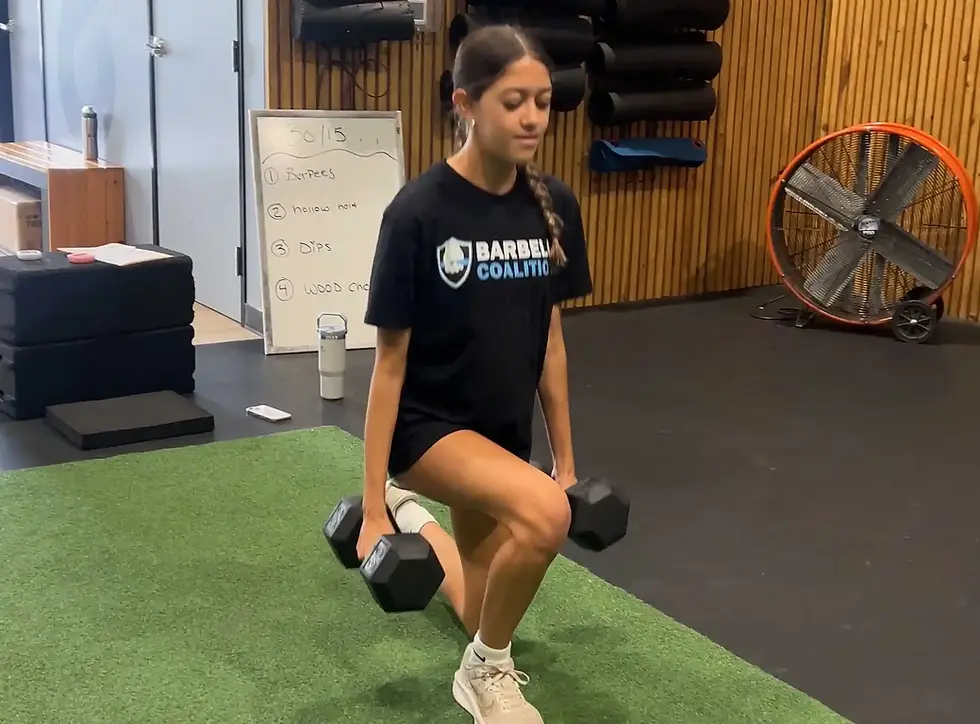
Good exercises are stable enough for the athlete to use sound technique and make measurable progress. Split squats, rear-foot-elevated split squats, step-ups, single-leg Romanian deadlifts, and controlled lateral lunges can all work when they match the athlete’s level.
The exercise should not look like a circus balance challenge. If the athlete spends the entire set wobbling, the movement may be too advanced or too unstable to build much strength.
Landing and stopping drills can complement this work. Our guide to deceleration training explains how athletes learn to absorb force before changing direction again.
How It Supports Speed and Change of Direction
Stronger legs can apply more force into the ground, but sport speed also depends on direction, timing, posture, and coordination. Single-leg strength provides capacity; sprint and agility practice teaches the athlete how to use it.
That is why strength work should sit beside—not replace—quality acceleration practice. See how those pieces fit together in our guide to improving first-step quickness.
How Much Single-Leg Work Is Enough?
Most youth athletes do not need a separate day filled with single-leg exercises. One or two well-chosen movements in a session can be enough when the sets are coached, recorded, and progressed over time.
A common starting range is two to four sets of controlled repetitions. The exact number depends on the exercise, the athlete’s experience, the rest of the workout, and the demands of practices and games.
During the competitive season, volume may be reduced so the athlete keeps the benefit without carrying unnecessary fatigue. Our in-season strength guide explains that adjustment.
What Parents Should Watch For
The athlete can keep the foot planted and the knee controlled.
The repetition looks similar from the first rep to the last.
The load increases only after the athlete owns the movement.
Training improves confidence and control instead of creating constant soreness.
Exercises are adjusted around the athlete’s age, experience, and sport schedule.
How Barbell Coalition Progresses Single-Leg Strength
We begin with positions the athlete can control, then build range of motion, repetitions, and load in a sensible order.
Some athletes start with support or a smaller range. Others are ready for loaded split squats, step-ups, or more demanding variations.
The objective is not to make every athlete perform the hardest version. It is to choose the version that produces good work today and leaves a clear next step for tomorrow.
Cedar Park Parents: Give Your Athlete a Clear Starting Point for Training
If your athlete needs a more organized plan for strength, speed, and movement, explore the 30-Day Athlete Accelerator. If your athlete does not improve, they receive two additional weeks free.


Comments